


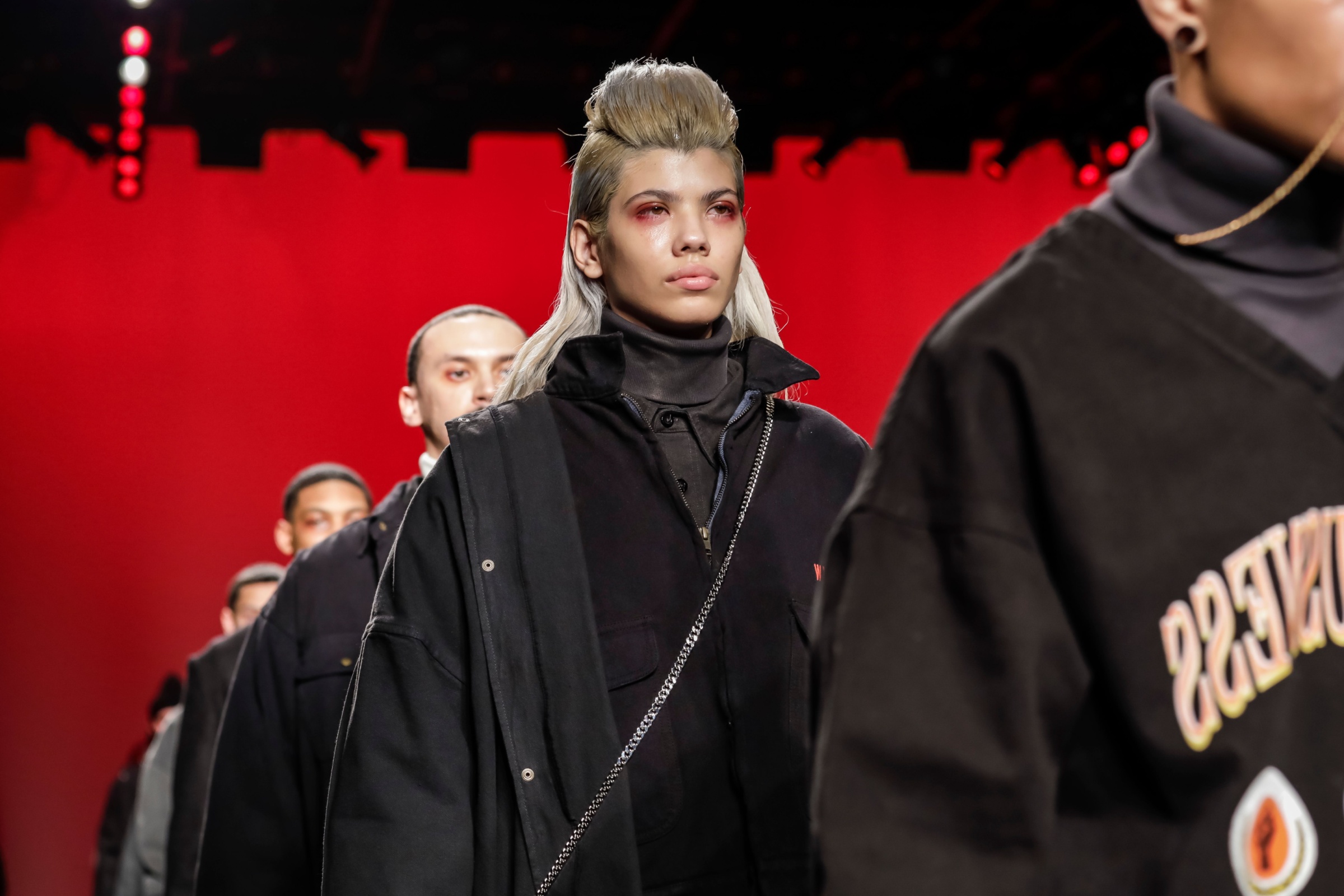
The Willy Chavarria-Zara collection will launch on March 26, bringing the designer’s aesthetic to a far larger audience. It includes menswear, womenswear, jewelry, and shoes. The collaboration marks Zara’s latest designer project during an unusually active period for the retailer. Chavarria said the goal was wider access without lowering quality.
The collection is titled VATÍSIMO. Chavarria described that as the superlative form of “vato,” a colloquial term used in the Chicano community. He said the word can refer to friends, partners, homies, and loved ones. That naming gives the project a strong cultural identity from the start.
The Collection Mixes Accessibility With Signature Shape
The Willy Chavarria-Zara collection was designed to feel accessible, but still recognizably his. Chavarria said he wanted to share the brand at more approachable price points. At the same time, he said Zara and his team focused closely on craftsmanship and detail. He also said the pieces were meant to stay in wardrobes for years.
That balance is visible in the product mix described by the launch coverage. The collection includes wide-leg khaki shorts with a crisp, angled shape. It also features a denim shirtdress in a soft marbled blue wash. A sharp-shouldered black blazer appears as one of the drop’s standout tailored pieces.
Chavarria highlighted slim silhouettes and relaxed tapered trousers as personal favorites from the line. He also pointed to cupro work shirts and a white suit he called “divine.” Although the collection includes men’s and women’s categories, he suggested shoppers cross those boundaries freely. That comment reflects the fluid styling approach already associated with his label.
The Campaign Leans Into Telenovela Energy
The Willy Chavarria-Zara collection is being introduced through a campaign styled like an old-school telenovela. The images were shot by Glen Luchford. The cast includes Christy Turlington and Alberto Guerra. Chavarria also appears in the campaign himself.
He described the ads as “extremely chic with a bit of humor.” That tone matters because it aligns with the broader public image of his brand. His runway work often combines seriousness, sensuality, and social meaning with theatrical flair. The Zara campaign appears to translate that energy into a more pop-facing retail format.
The campaign’s styling also helps sell the collection as more than just a product drop. It frames the release as a character-driven fashion event. That approach gives Zara a stronger narrative hook than a standard collaboration launch. It also allows Chavarria’s world-building instincts to remain visible within a mass-retail structure.
The Release Comes During A Big Year For Chavarria
The Willy Chavarria Zara collection arrives after a busy stretch for the designer. The launch coverage described 2026 as already a strong year for him. It noted his critically praised Paris show in January. It also pointed to recent celebrity styling and sneaker visibility in sports culture.
That momentum gives the Zara project extra weight. This is not a comeback or a rescue collaboration. Instead, it arrives while Chavarria’s profile is already rising across runway, celebrity, and commercial fashion spaces. As a result, the collection looks less like a detour and more like an expansion.
Zara, meanwhile, is also using collaborations more aggressively as part of its fashion positioning. The same coverage noted the retailer’s recent work dressing Bad Bunny for the Super Bowl. It also referenced Zara’s announced two-year partnership with John Galliano, set to begin in September. That context places Chavarria inside a broader strategy.
New York Pop-Up And Online Launch Expand The Reach
The Willy Chavarria-Zara collection will be sold through a special New York pop-up at 73 Spring Street. The pop-up opens on March 26, the same day as the collection launch. Shoppers outside New York will also be able to buy the pieces online. That dual release plan suggests Zara expects strong interest beyond one local market.
The project’s strongest hook may be its combination of specificity and scale. Chavarria is bringing a highly recognizable point of view into one of the world’s biggest retail systems. That can flatten a designer’s identity if handled poorly. Here, the early details suggest Zara is instead leaning into what makes his work distinct.
For fashion watchers, that makes the Willy Chavarria-Zara collection more interesting than a routine celebrity-style drop. It carries a cultural frame, a defined silhouette language, and a rollout built like an entertainment rollout. Whether shoppers treat it as collectible or wearable, the launch is clearly designed to feel like an event.