


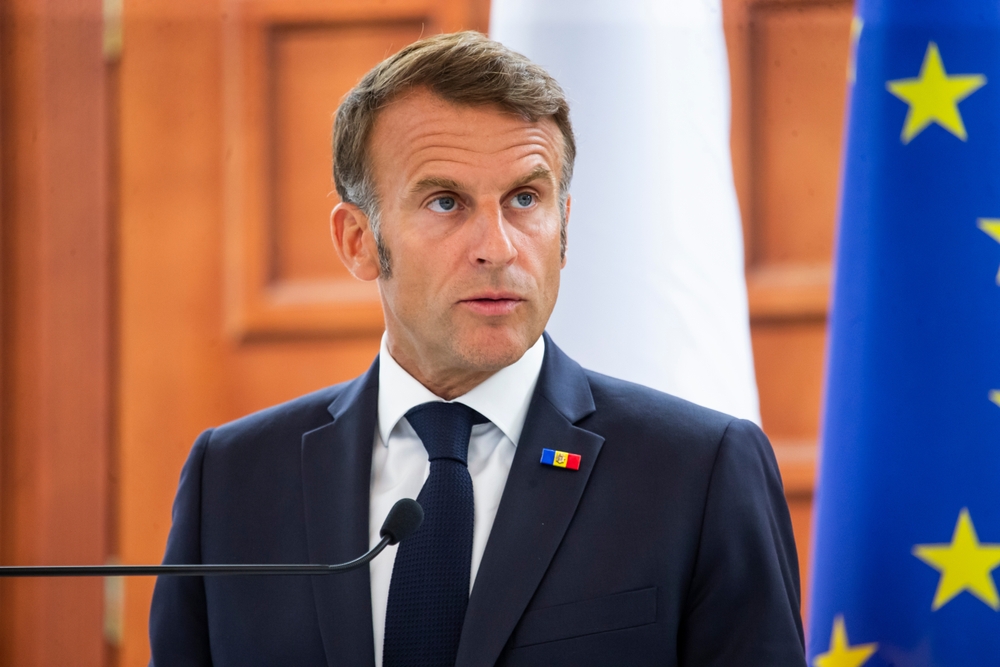
Charles de Gaulle redeploys from Baltic with full escort
French President Emmanuel Macron ordered France’s nuclear-powered aircraft carrier Charles de Gaulle to move from the Baltic Sea to the Mediterranean, positioning it closer to the Middle East as the conflict with Iran spreads across the region. Macron said the carrier will deploy with frigates and its air wing, a move he framed as support for allied security and the protection of partner assets.
In a prerecorded address broadcast on French television, Macron said France has also deployed Rafale fighter jets, air-defense systems, and airborne radar capabilities to the Middle East over the past few hours. “And we will continue this effort as much as necessary,” he said.
France, the United Kingdom, and Germany have previously said they were not involved in the U.S. and Israeli strikes on Iran that began late last week. They have said they are prepared to take defensive action aimed at reducing Iran’s ability to launch missiles and drones.
France says it shot down drones defending allied airspace
Macron said French forces had already intercepted drones in what he described as legitimate self-defense. He said the action occurred in the first hours of the conflict to protect the airspace of allied partners, adding that allies know they can rely on France. He did not provide further operational details.
He cited Monday’s strike on a British air force base in Cyprus as part of the rationale for the carrier movement, noting Cyprus is a member of the European Union and that France has recently signed a strategic partnership with it. “This requires our support,” Macron said.
Macron said France has defense agreements binding it to Qatar, Kuwait, and the United Arab Emirates, and added that France has strong commitments to Jordan and Iraq. The comments underline Paris’s view that the conflict has direct implications for European and regional partners, not only for Israel and Iran.
Macron warns Hezbollah and urges Israel to avoid ground escalation
Macron said the war has also extended into Lebanon and blamed Hezbollah, which is backed by Iran, for escalating the situation. He said Hezbollah made what he called the grave mistake of striking Israel and placing the Lebanese population at risk.
At the same time, Macron warned against Israel launching a ground operation in Lebanon. “This, too, would be a dangerous escalation and a strategic error,” he said. He called on Hezbollah to halt strikes and urged Israel to respect Lebanese territory and its integrity.
France rejects legality of strikes but blames Iran for the crisis
Macron said France cannot approve of the U.S. and Israeli strikes on Iran because they were carried out outside what he described as the framework of international law. He said ending the strikes as quickly as possible would be desirable and argued that lasting peace can only come through renewed diplomatic negotiations.
He expressed hope that the Iranian people could freely determine their future, while also making clear that he does not expect sympathy for Iran’s leadership. Referencing the killings of Iran’s Supreme Leader Ayatollah Ali Khamenei and other senior officials, Macron said history does not mourn those he described as executioners of their own people.
Macron also placed responsibility for the crisis on Iran, citing Tehran’s nuclear program, ballistic missile capabilities, and support for armed groups in neighboring countries. He said Iran armed and financed Hezbollah in Lebanon, the Houthis in Yemen, Shiite militias in Iraq, and supported Hamas, while repeatedly stating its objective of destroying Israel.