


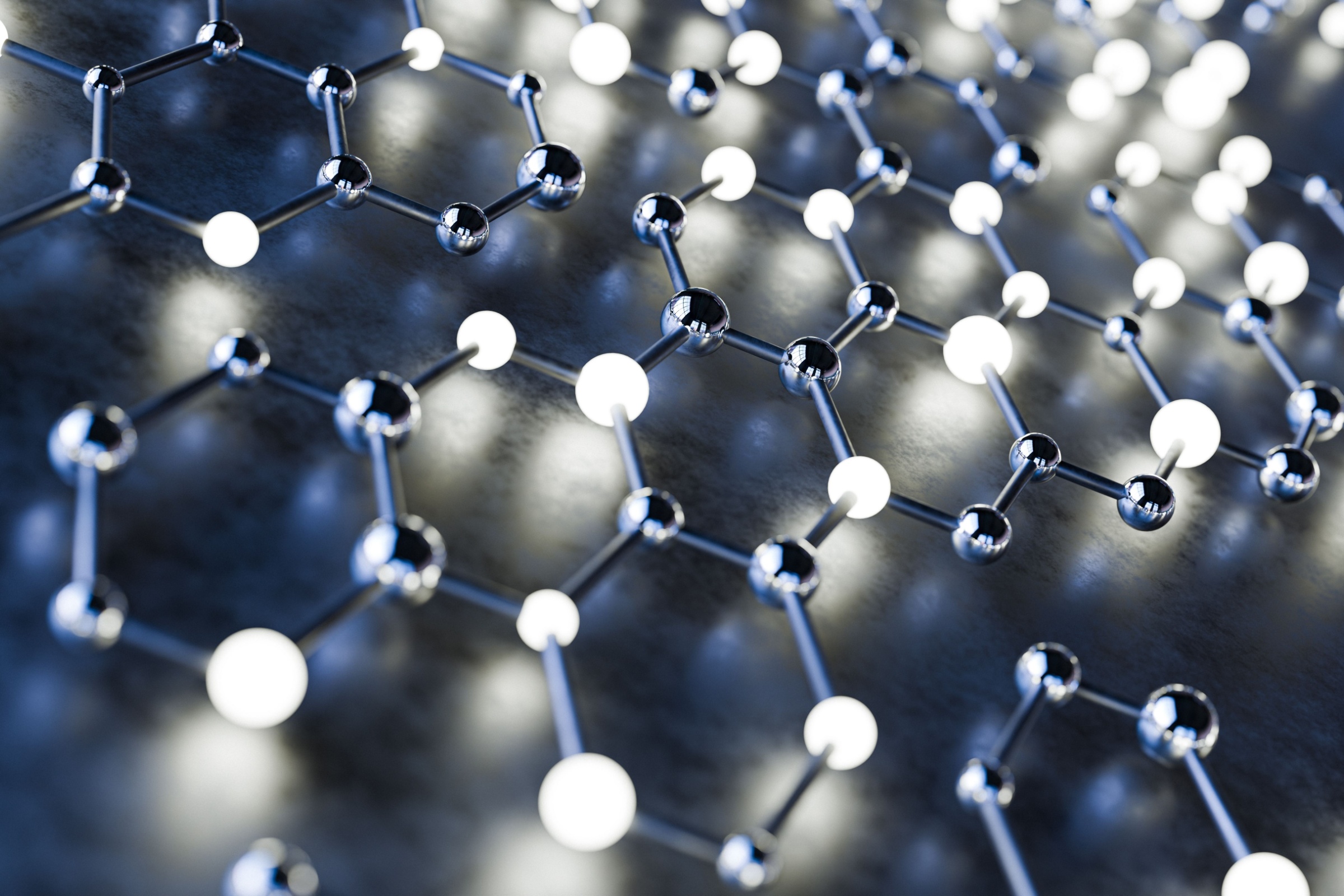
Researchers say graphene breaks a classic rule of physics under special conditions that let electrons move together like a near-frictionless liquid. The work comes from the Indian Institute of Science and collaborators in Japan, who studied ultra-clean graphene and reported the results in Nature Physics.
Graphene is a one-atom-thick sheet of carbon. Physicists have studied it for years because its electrons can behave in unusual ways. In this case, the team found evidence for an elusive quantum state in which electrons stop acting like mostly independent particles and instead flow collectively.
Heat and Charge Stopped Following the Same Rule
The key result involved two basic properties: how well graphene carried electricity and how well it carried heat. In ordinary metals, those two usually track each other. That relationship is described by the Wiedemann-Franz law, a long-standing principle of condensed-matter physics.
But in these graphene samples, the two no longer moved together. As electrical conductivity rose, thermal conductivity fell, and vice versa. The researchers said the deviation from the Wiedemann-Franz law exceeded 200 times at low temperatures. That made the result especially striking.
The team also found that the behavior was not random. Both kinds of transport appeared linked to a universal quantum scale tied to the quantum of conductance, which helps describe how electrons move at very small scales.
The Strange State Appeared at Graphene’s Dirac Point
The effect emerged near graphene’s Dirac point, a special condition where the material sits at the boundary between metallic and insulating behavior. By tuning the number of electrons carefully, the researchers pushed graphene into that regime.
At that point, the electrons formed what physicists call a Dirac fluid. Instead of moving as separate carriers, they flowed together in a collective state. The researchers measured the fluid’s viscosity and found it was extremely low, making it one of the closest lab examples of a nearly perfect fluid. The authors compared it to the quark-gluon plasma studied in high-energy particle experiments.
Why the Result Matters Beyond Graphene
The study gives physicists a more accessible way to test ideas that usually belong to extreme environments. The researchers say graphene could now serve as a lab platform for studying concepts linked to high-energy physics and astrophysics, including black-hole thermodynamics and entanglement entropy scaling.
The work may also matter for technology. The team said this Dirac-fluid behavior could support future quantum sensors that detect very weak electrical signals or faint magnetic fields. For now, the bigger significance is fundamental: graphene breaks a classic rule of physics by separating heat flow from charge flow in a way ordinary metals do not.